TASEP Model
Totally Asymmetric Simple Exclusion Process (TASEP) is an ideal model in nonequilibrium statistical mechanics. It is useful in modeling a wide range of transport phenomena including road traffic and translation of mRNA in protein synthesis. A 1D open ended lattice is considered here. The dynamics is governed by the following set of rules:
- Particles enter from the left end with an entry rate $\alpha$.
- Particles can only move towards the right (totally asymmetric movement).
- Particles can hop to the adjacent site on the right only if it is empty (exclusion interaction).
- Particles leave from the site at the right end with an exit rate $\beta$.
Input parameters
- lattice-size : Number of sites on the lattice
- $$\alpha$$ : particle entry rate ($$0 < \alpha < 1$$)
- $$\beta$$ - particle exit rate ($$0 < \beta < 1$$)
Outputs
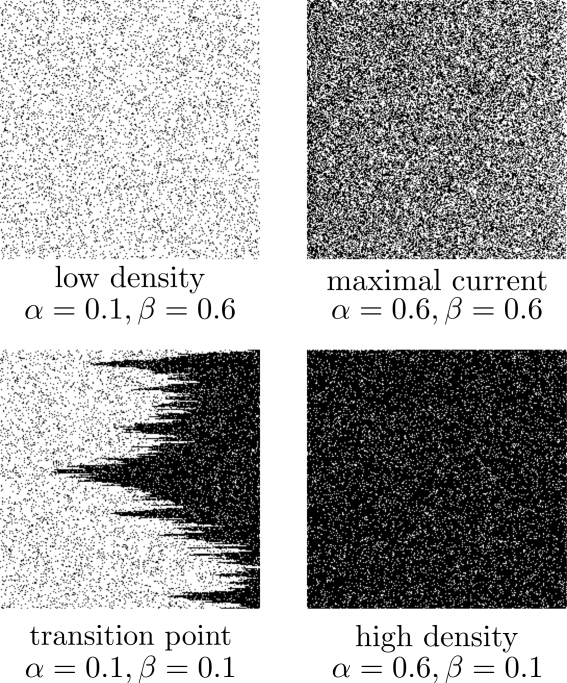
config.png: shows the monte carlo evolution of the lattice. Each horizontal line of pixel represent one lattice configuration at a timestep.- Particle current : The number of particles exiting the lattice per unit time (in simulation units)
Three phases of the TASEP
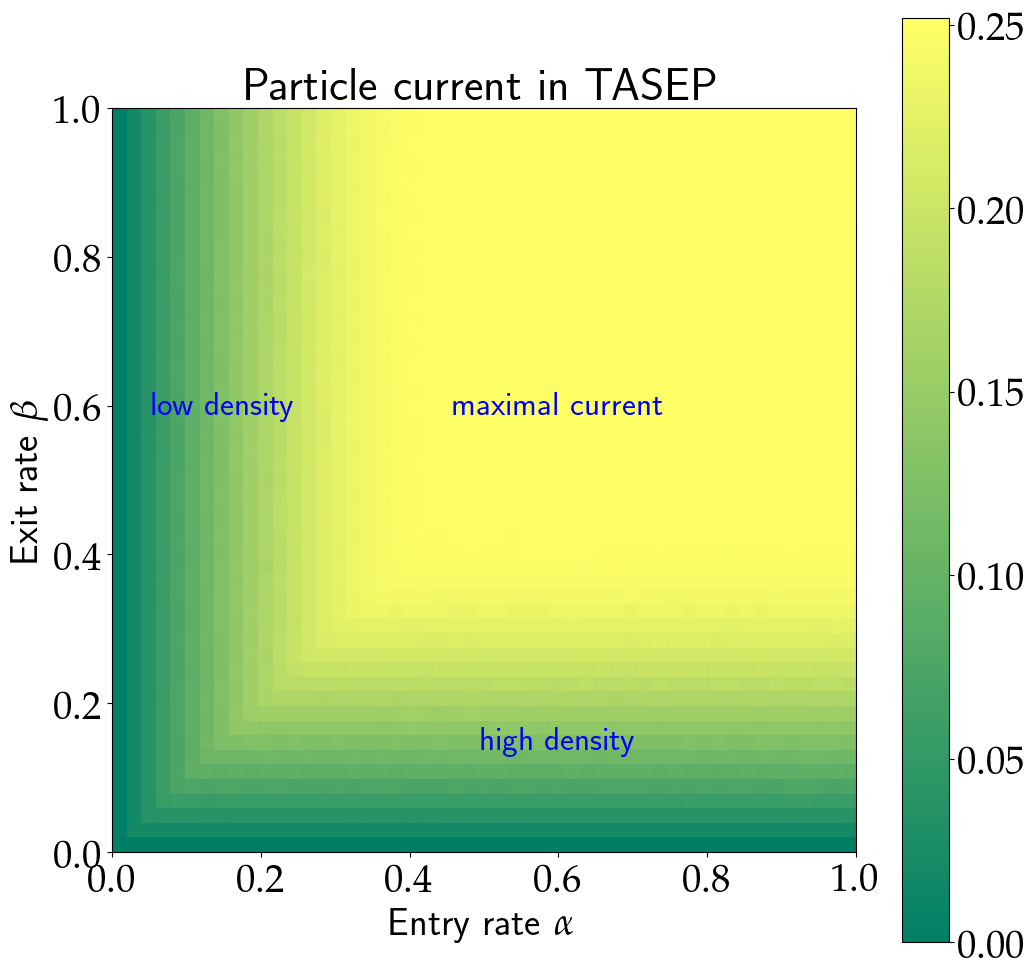
Depending on the entry and exit rates, three phases are observed for the TASEP.
- Low density phase at low entry rate ($$\alpha < 0.2$$) and high exit rate ($$\beta > 0.2$$)
- High density phase at high entry rate ($$\alpha > 0.2$$) and low exit rate ($$\beta < 0.2$$)
- Maximal current phase at high entry rate ($$\alpha > 0.3$$) and high exit rate ($$\beta > 0.3$$)
Demonstration
Particle current : 0.0
Last updated on May 11, 2019